
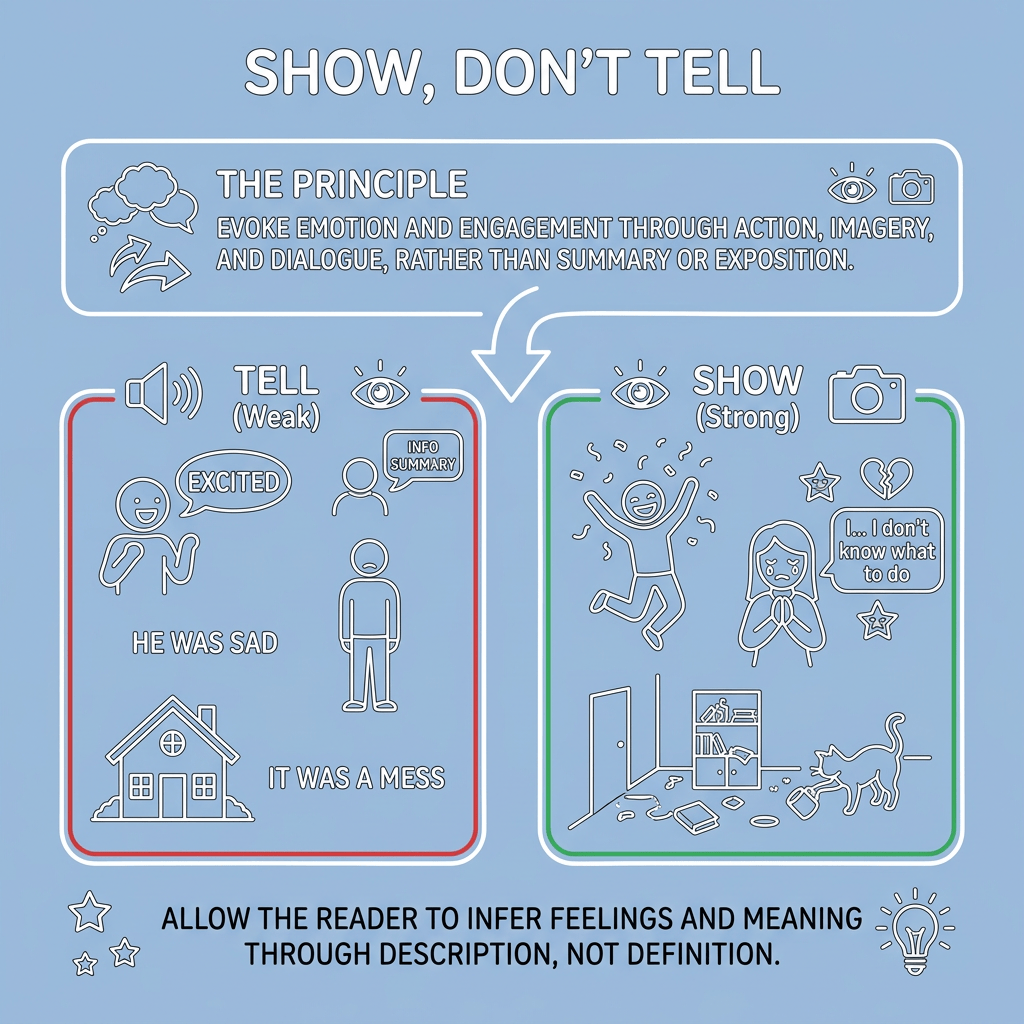
Today, we’re diving deep into one of the most important principles of storytelling: “Show, don’t tell.” ✍️
You might have heard this phrase before and wondered what it really means. Don’t worry, I’m here to break it down for you und give you some easy tips! ✨
What does “Show, don’t tell” even mean? 🧐
Simply put, “Show don’t tell” means that instead of telling your readers what is happening, you show them through vivid descriptions and specific details. 🗣
👉 It’s about making your readers experience the story and connect with your characters without info-dumping. You don’t want a whole page of information, you want them naturally and little by little. 🌿
Why is this important? 🌱
Imagine, you’re reading a story and the narrator says something like: “He was very angry.” 🚫
Sure, you know now that the character is angry, but do you feel it? 💭Probably not.
Now, imagine you read this instead: “His hands clenched into fists, and his face turned red. He ground his teeth, and his eyes stormed across he room.” 🖋
Now you can feel the anger, right? You can practically see it and sense it but in a natural, organic way that keeps the reading flow. ✅
How to master “Show, don’t tell” 🖋
Here are some easy and quick tips to help you to master “Show, don’t tell”:
- Use sensory details: Engage your reader’s senses. Describe what your characters see, hear, taste, smell and touch. This makes your scenes more immersive. 👁
- Describe actions: Show how characters react to situations. Their actions often speak louder than words! How is the mimic or the body language? ✍️
- Use dialogue: Let your characters words reveal their emotions and thoughts. Dialogue can be a powerful tool to show what’s actually going on inside their heads. But of course, don’t info-dump. 💬
- Use metaphors: These can paint vivid pictures in your readers mind and evoke emotions. But: Less is more! 💭
And last but not least: Practice makes perfect 🔄
When it comes to creative writing, there are many skills that take time to develop. 📖 “Show, don’t tell” is exactly that kind of a skill.
But with practice, it will become second nature to you. 🌿 The more you write, the more you will find yourself naturally showing rather than telling. ✅ And don’t worry, you can always edit later! ✨
Final thoughts 🦋
Remember, the goal of “Show, don’t tell” is to make your writing more engaging and to draw your readers into the world you’ve created. 🌈 So next time you’re writing, challenge yourself to show more and tell less. ⭐️
Happy writing, your Katharina. 🌊



 Katharina Romes
One response to “show don’t tell – or why less is sometimes more 🧐”
[…] 3 Show don’t tell […]
LikeLike